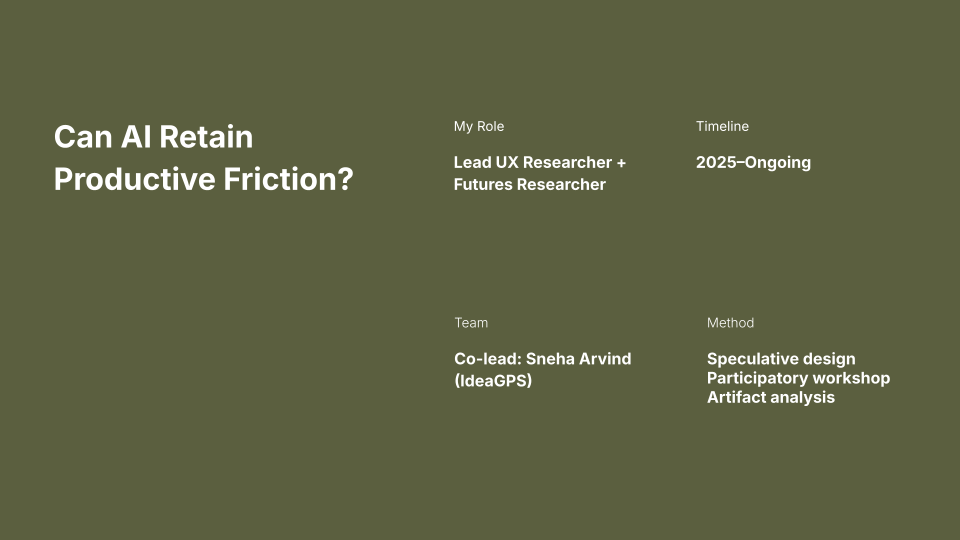
Context
AI tools tend to make tasks easier. They follow familiar UX principles: reduce memory load, cut the number of steps, and let people recognize rather than recall. However, learning science suggests that some effort is part of how understanding forms: working through confusion, trying and failing, and reasoning toward an answer.
This project asks what effort we should keep when learning with AI, and what forms AI could take beyond the chatbot, like objects, tools, wearables, and rituals that support embodied, creative, and social learning.
Why friction matters in learning
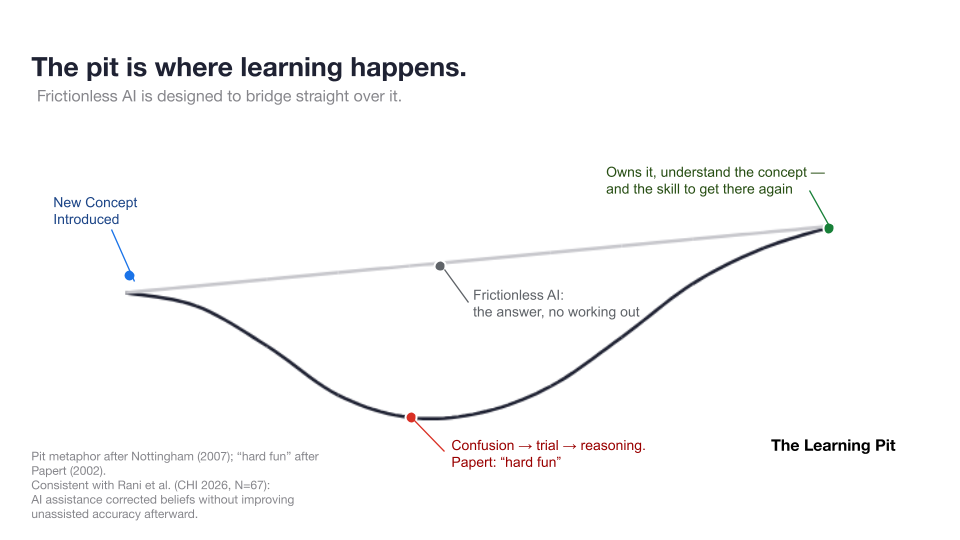
Pit metaphor after Nottingham's Learning Pit; "hard fun" after Papert.
The learning pit is where understanding takes shape: the confusion, trial, and reasoning between meeting an idea and owning it.
AI tools can reduce this effort. Early research on cognitive de-skilling suggests that skipping the pit may also mean missing some of the learning.
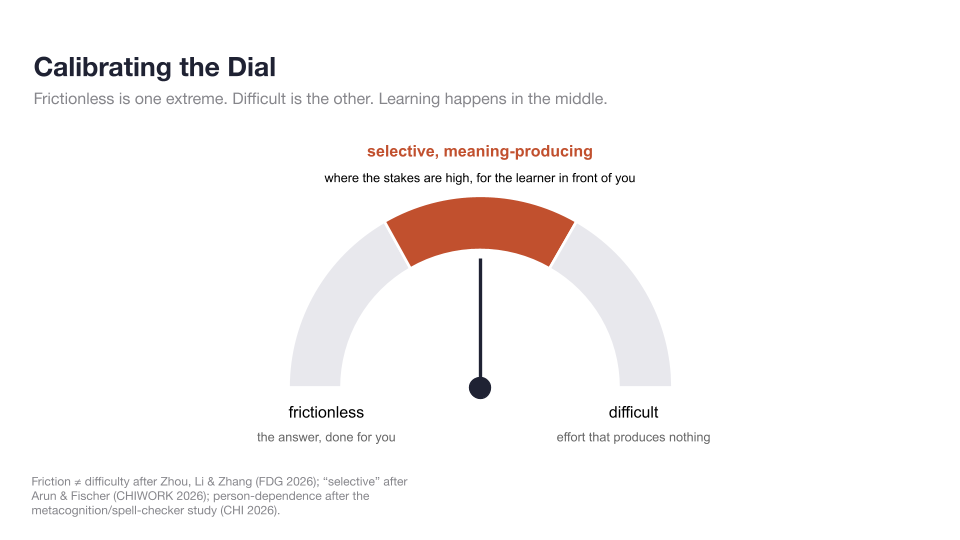
The right setting depends on the task, the learner, and what is at stake.
Task: Is the goal to finish the task, or to learn from doing it?
Expertise: Can this learner meet the effort yet, or do they need the steps shown first?
Stake: Does the learner care about this, and is it worth the extra effort?
Expertise: Can this learner meet the effort yet, or do they need the steps shown first?
Stake: Does the learner care about this, and is it worth the extra effort?
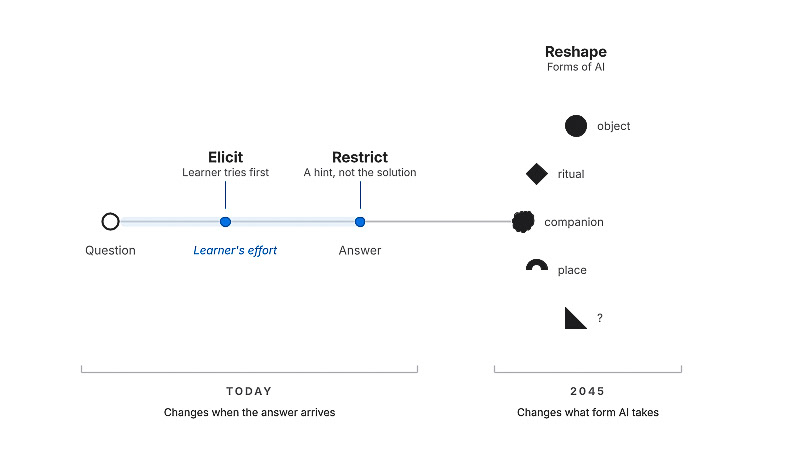
Many AI learning tools today change when and how an answer arrives.
What embodied forms might AI take in learning, beyond the chatbot?
What embodied forms might AI take in learning, beyond the chatbot?
Process
Workshop at a glance
Method: Speculative design to look past today's chatbot interfaces.
Team: Co-designed with Sneha Aravind.
Premise: A time machine to a 2045 learning environment, adapted from Julian Bleecker.
Task: Bring back an object, ritual, or practice that shows how AI is, or is not, part of learning.
Team: Co-designed with Sneha Aravind.
Premise: A time machine to a 2045 learning environment, adapted from Julian Bleecker.
Task: Bring back an object, ritual, or practice that shows how AI is, or is not, part of learning.
About the workshop ↓
🌱 This work is ongoing, and the detailed results are held back until publication.
If you'd like to learn more, please reach out.
If you'd like to learn more, please reach out.